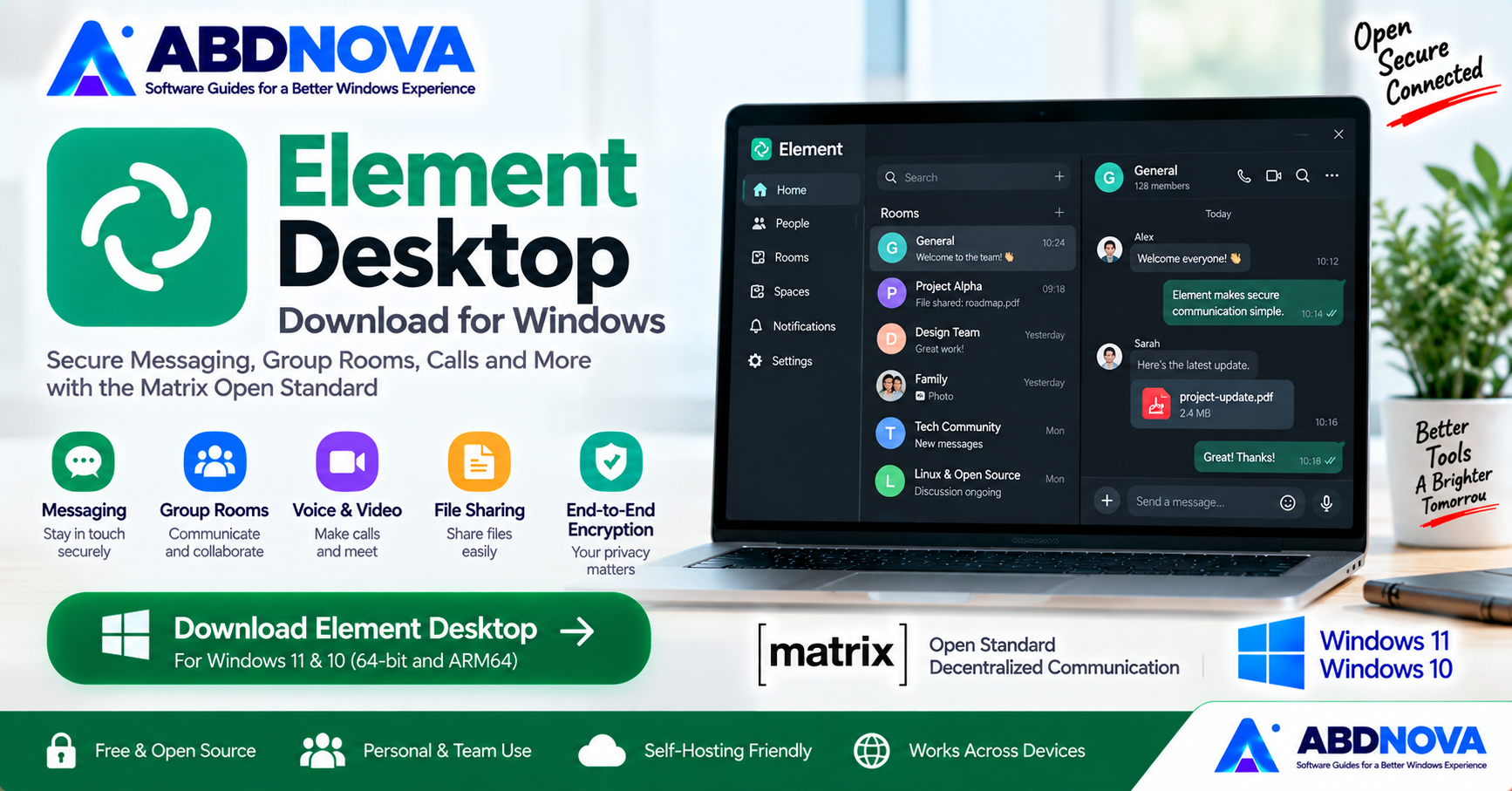

Element Desktop Download for Windows 11 & 10
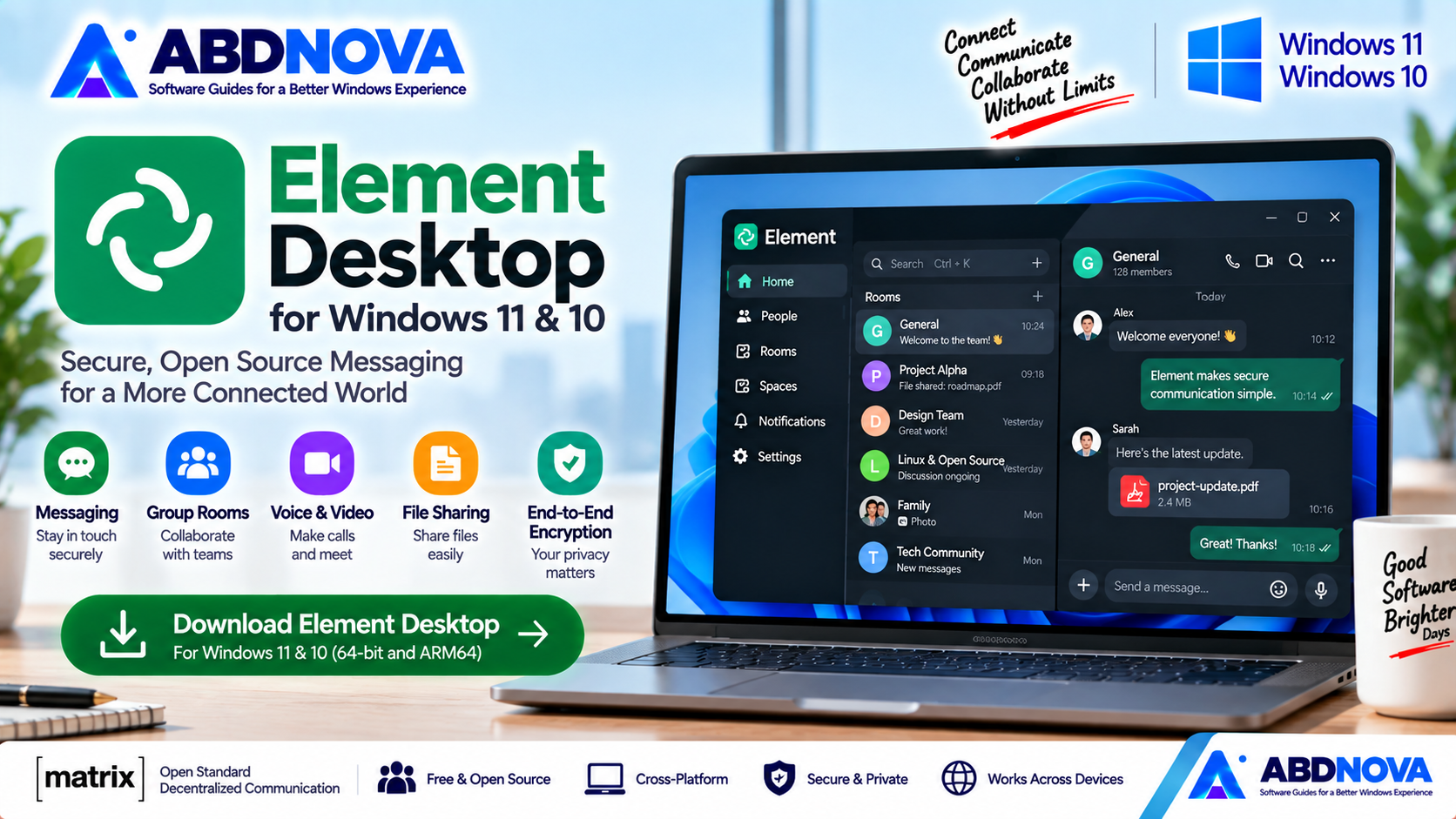
Download Element Desktop for Windows 11 and 10 to use Matrix messaging, encrypted rooms, Spaces, voice and video calls, file sharing and decentralized communication from your PC.
Element Desktop Download for Windows gives Windows users a secure, open-source messaging and collaboration application built on the Matrix open standard.
Element combines private messaging, group rooms, voice and video calls, file sharing, Spaces, device verification and decentralized communication inside one desktop client.
It is particularly useful for users and organizations that want more control over communication infrastructure than they typically get with centralized messaging services.
You can use Element with Matrix.org, another Matrix provider or a self-hosted Matrix server.
Element Desktop for Windows at a Glance
| Information | Details |
|---|---|
| Software | Element Desktop |
| Developer | Element |
| Platform | Windows, macOS, Linux, Web |
| Network | Matrix |
| License | Open Source |
| Current Stable Version | 1.12.27 |
| Release Date | September 1, 2026 |
| Windows 64-bit | Available |
| Windows ARM64 | Available |
| Messaging | Yes |
| Group Rooms | Yes |
| Spaces | Yes |
| Voice & Video Calls | Yes |
| Screen Sharing | Supported |
| File Sharing | Yes |
| End-to-End Encryption | Supported |
| Device Verification | Yes |
| Secure Backup | Yes |
| Self-Hosting | Supported |
| Personal Use | Free |
Element’s current official Windows installers include standard 64-bit and ARM64 builds. The current stable installer is version 1.12.27. :contentReference[oaicite:2]{index=2}
Download Element Desktop for Windows 11 & 10
The safest way to get Element Desktop is through the official Element download page.
For most Windows computers using Intel or AMD processors, choose the normal Windows 64-bit installer.
If you use an ARM-based Windows computer, choose the dedicated Windows ARM64 build. Element currently provides both options on its official download page. :contentReference[oaicite:3]{index=3}
- Element cracks.
- Modified Element installers.
- Pre-activated builds.
- Unofficial repacks.
- Unknown third-party installers.
Element’s personal client is already available free of charge, so there is no legitimate reason to install a modified version.
Element Desktop for Windows 11
Element Desktop works well as a dedicated Matrix client on Windows 11.
Instead of keeping Element open in a browser tab, the desktop application provides a dedicated interface for rooms, private messages, calls, notifications, Spaces and shared files.
For most conventional Windows 11 PCs with Intel or AMD processors, the 64-bit build is the correct choice. ARM-based Windows 11 computers should use Element’s ARM64 version.
Element Desktop for Windows 10
Element Desktop can also run on compatible Windows 10 computers.
If you are installing Element today, use the latest official desktop installer rather than an older version from a third-party website.
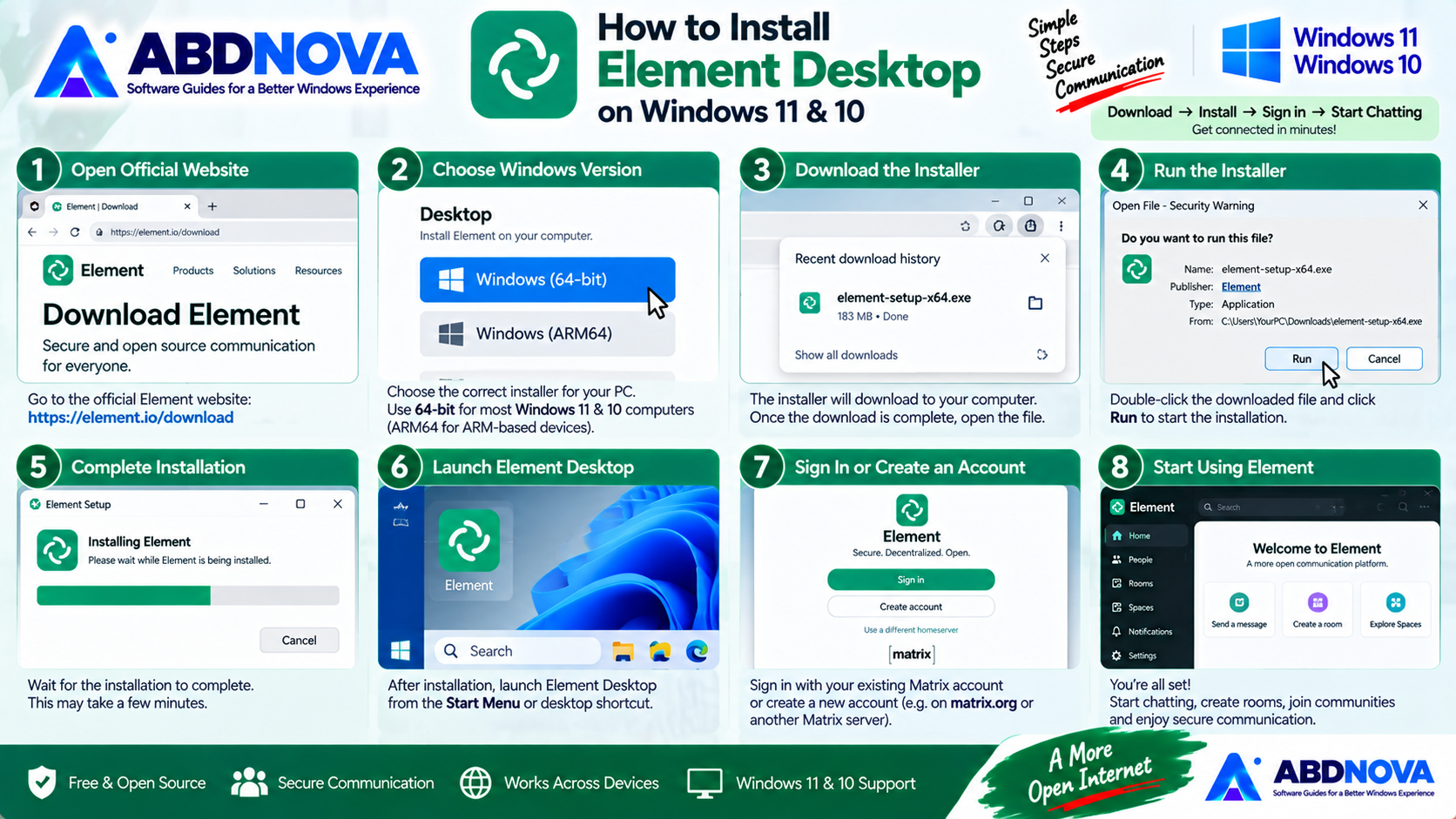
How to Install Element Desktop on Windows
- Open the official Element download page.
- Find the Desktop section.
- Select Windows 64-bit or Windows ARM64 for your processor.
- Download the Element Setup file.
- Open the downloaded installer.
- Allow installation to complete.
- Launch Element Desktop.
- Sign in to your Matrix account or follow the available account setup options.
Element usually uses Matrix.org as the default homeserver configuration, but you can also connect to another Matrix homeserver where appropriate.
What Is Matrix?
Matrix is an open standard for decentralized real-time communication.
Instead of forcing every user to communicate through one central service provider, Matrix allows different compatible servers to communicate with one another.
- Private messaging.
- Group rooms.
- Communities.
- Voice and video communication.
- File sharing.
- Federation between servers.
- Self-hosted deployments.
This decentralized architecture is one of the biggest differences between Element and mainstream centralized messaging applications.
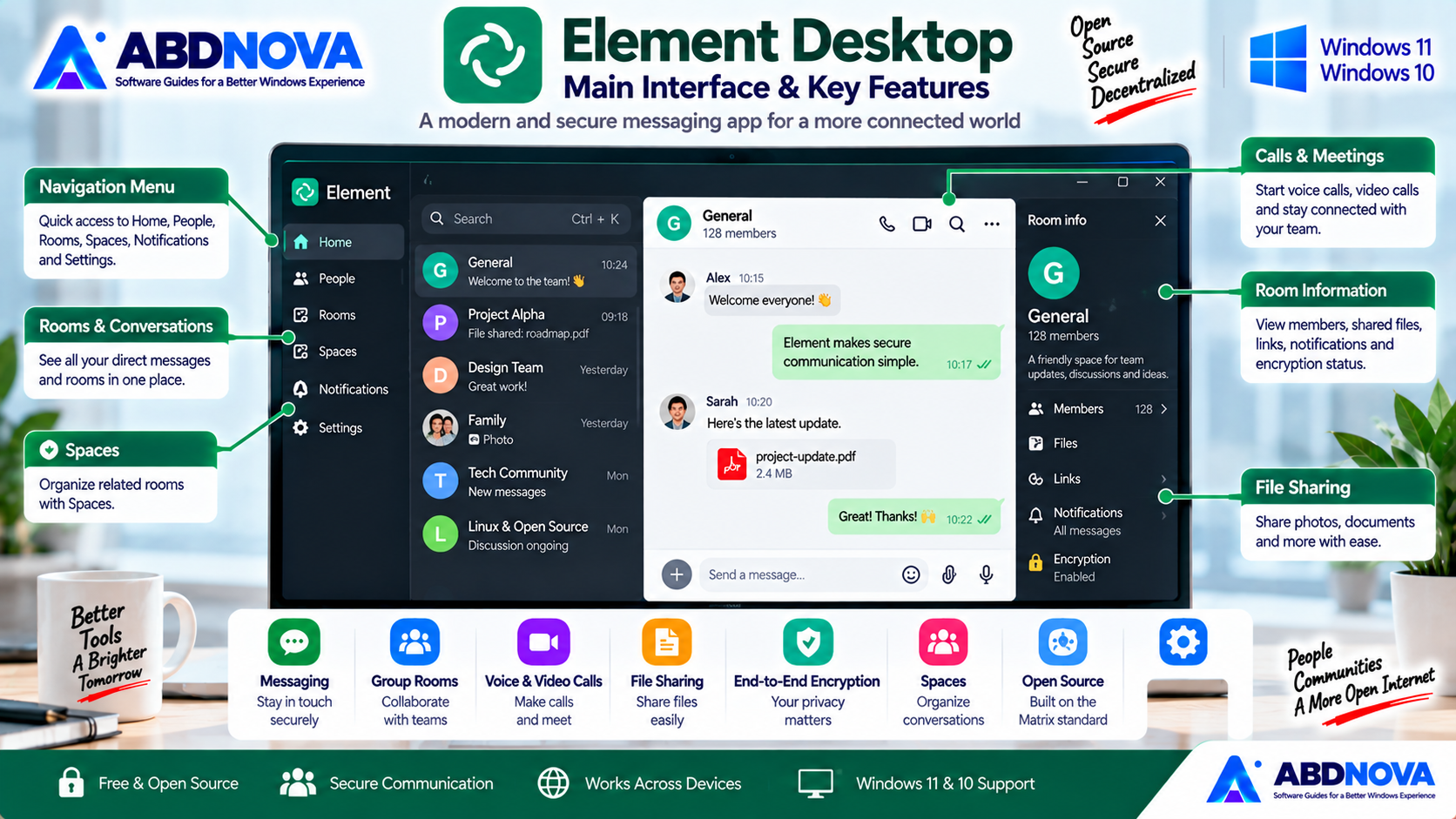
Element Desktop Main Interface & Key Features
Element organizes communication around rooms.
A room can represent:
- A private conversation.
- A group discussion.
- A project.
- A community.
- A support channel.
- A study group.
- An organization or team.
The desktop interface gives quick access to conversations, people, Spaces, search, notifications, favorites, settings and room information.
This layout works particularly well on a desktop because you can move between several conversations while keeping a large message area visible.
Private Messages
Element supports direct conversations together with richer messaging features such as:
- Attachments.
- Reactions.
- Emoji.
- Polls.
- Voice messages.
- Replies.
- Read receipts.
- Message editing.
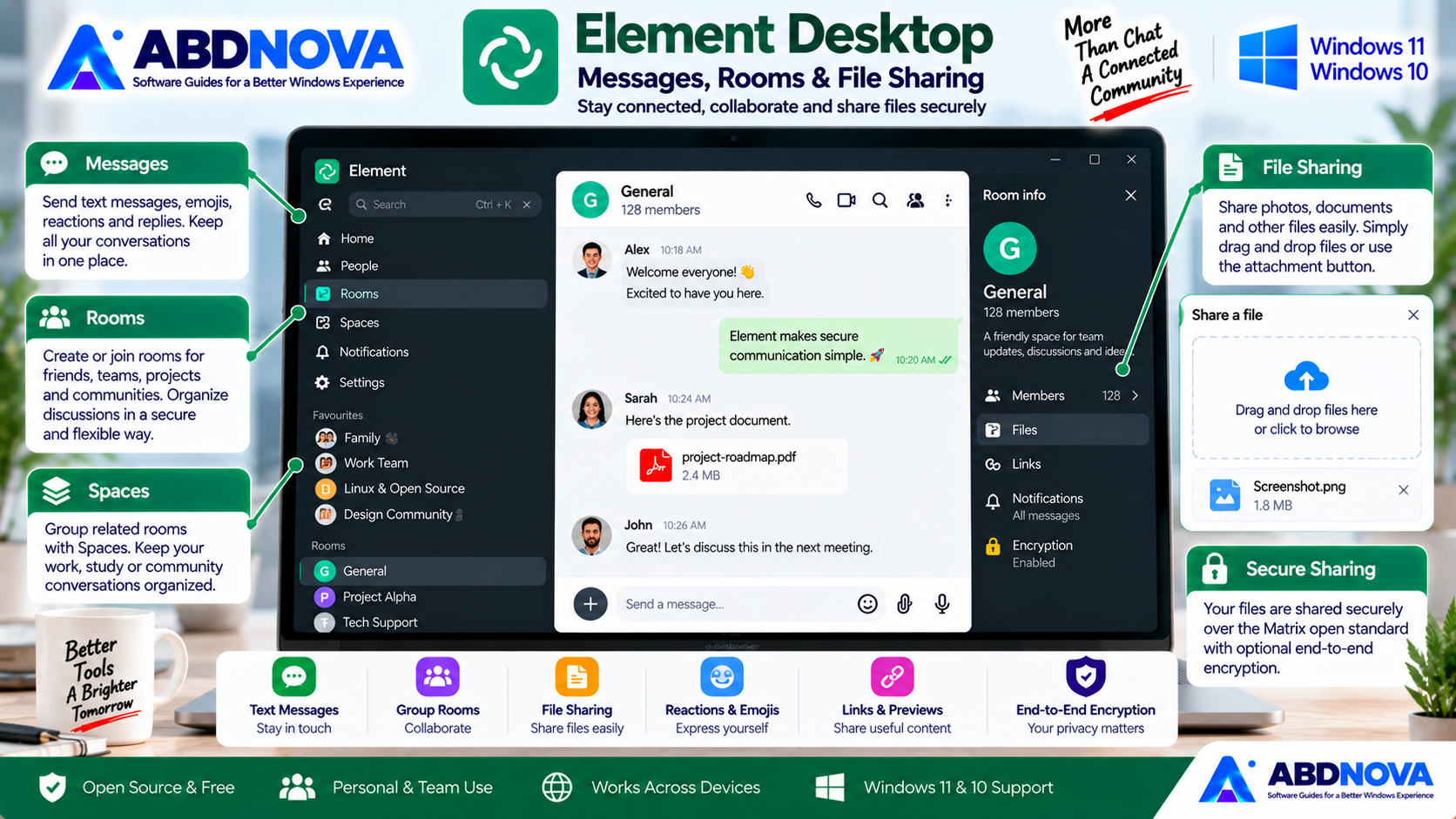
Element Messages, Rooms & File Sharing
Rooms & Group Chats
Rooms are one of the core parts of the Element and Matrix experience.
You can create rooms for:
- Friends and family.
- Work teams.
- Projects.
- Communities.
- Study groups.
- Clubs and organizations.
Private rooms can be configured as invite-only spaces, while larger deployments can use additional room and access-management controls.
Spaces
If you participate in many rooms, Spaces help organize related conversations.
Example Company Space
- Announcements.
- Support.
- Development.
- Marketing.
- General discussion.
This structure makes Element useful for both personal communities and more organized collaboration.
File Sharing
Element Desktop makes file sharing straightforward.
You can drag a file directly into a conversation or use the attachment control to browse your Windows PC.
This can be useful for:
- Documents.
- Images.
- Project files.
- PDFs.
- Other supported attachments.
Search
Element Desktop can search for messages and filenames.
Encrypted-room search is also available on Element Windows, macOS and Linux when the required setting is enabled in Security & Privacy. :contentReference[oaicite:4]{index=4}
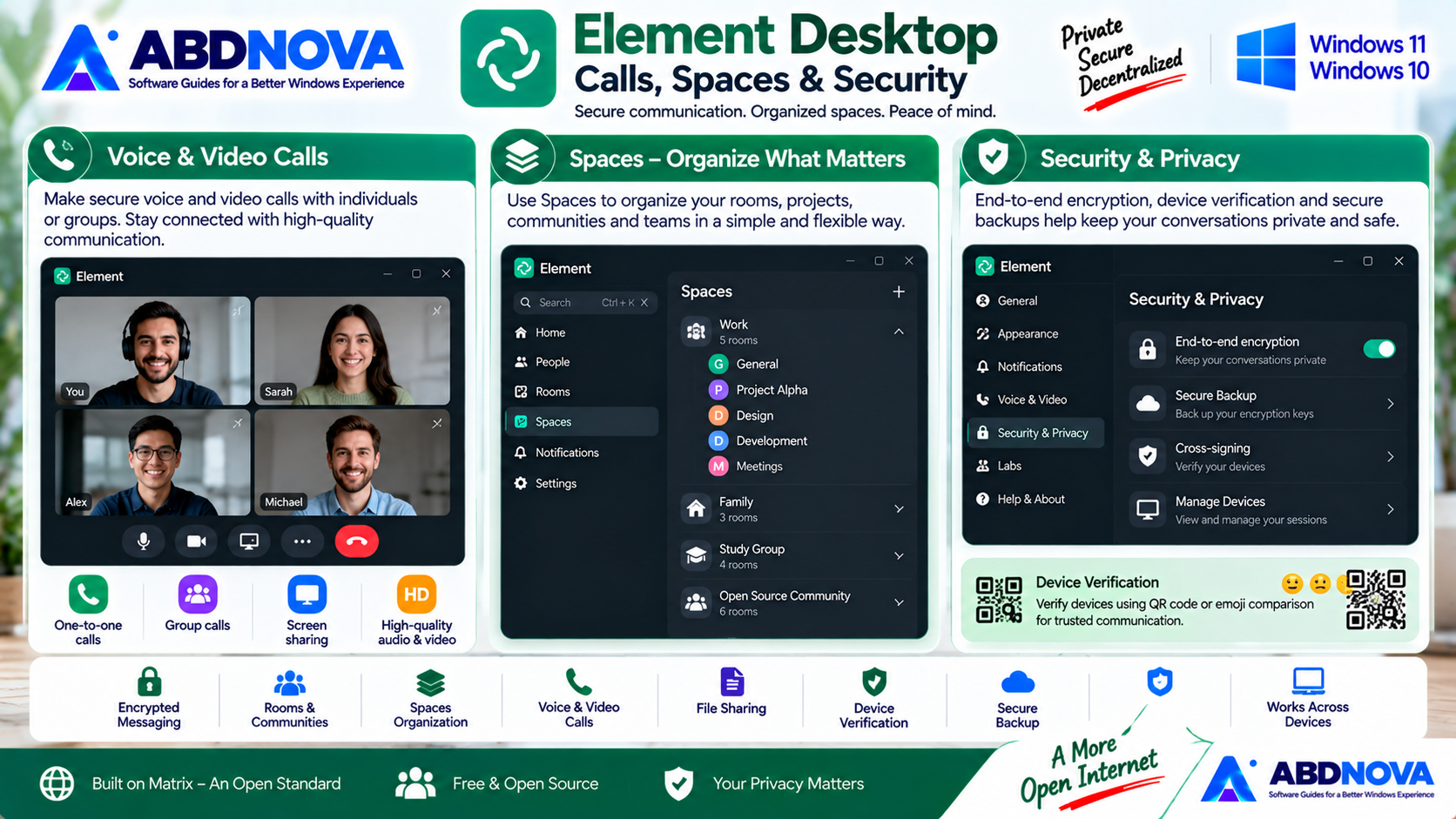
Element Calls, Spaces & Security
Voice & Video Calls
Element includes voice and video communication for one-to-one and group conversations.
Current calling technology uses Element Call and MatrixRTC for encrypted communication.
Depending on the deployment and configuration, calling can include:
- One-to-one voice calls.
- Video calls.
- Group calls.
- Conference-style communication.
- Screen sharing.
This allows users to move from text communication into live collaboration without switching to another application.
End-to-End Encryption
Privacy is one of Element’s major strengths.
Element uses Matrix encryption technology for end-to-end encrypted conversations.
When E2EE is enabled, messages are encrypted on users’ devices so that participants with the correct keys can decrypt them.
Secure Backup
Encrypted messaging makes key recovery important.
Element’s Secure Backup helps protect access to encrypted messages and data when you sign in on a new device or lose access to an existing session.
Element’s current onboarding documentation allows users to set up a security passphrase or recovery key. That information can later be used to restore access to encrypted data on another session. :contentReference[oaicite:5]{index=5}
Device Verification
Element allows devices and sessions to be verified so users can confirm that a new login really belongs to them.
Verification methods can include:
- Recovery key.
- Verification from an existing device.
- QR code.
- Emoji comparison.
Element’s current documentation says insecure devices are planned to lose the ability to send and receive messages from October 2026, making device verification increasingly important. :contentReference[oaicite:6]{index=6}
Decentralized Matrix Communication
Element’s underlying Matrix architecture allows different organizations to operate separate servers while still communicating through compatible Matrix systems.
This provides organizations with more control over communication infrastructure than a single centralized service normally allows.
Self-Hosting
Advanced users, companies, governments and organizations can operate their own Matrix infrastructure.
Self-hosting can provide greater control over:
- Data location.
- Server administration.
- User management.
- Security policies.
- Integrations.
- Network configuration.
Self-hosting is not required for ordinary personal use. Regular users can simply use an existing Matrix provider.
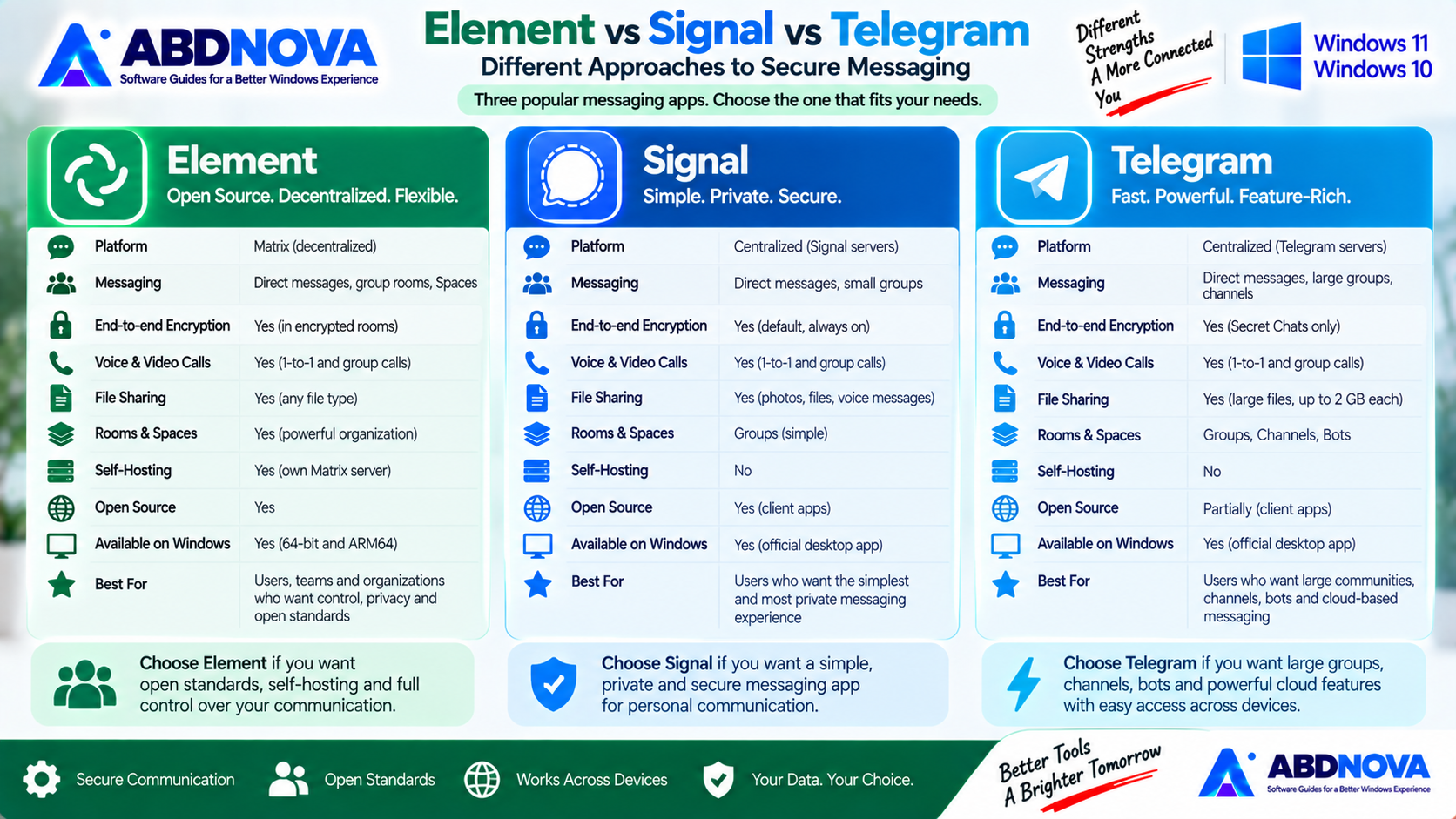
Element Desktop vs Signal vs Telegram
| Feature | Element | Signal | Telegram |
|---|---|---|---|
| Windows Desktop App | Yes | Yes | Yes |
| Open Source | Yes | Yes | Yes / components vary |
| Messaging | Yes | Yes | Yes |
| Rooms / Groups | Strong | Yes | Strong |
| Voice & Video Calls | Yes | Yes | Yes |
| File Sharing | Yes | Yes | Yes |
| End-to-End Encryption | Supported per room/deployment | Strong default private messaging | Secret Chats only for E2EE |
| Federation | Yes | No | No |
| Self-Hosting | Yes | No normal user server hosting | No |
| Spaces / Communities | Spaces & rooms | Groups | Groups & channels |
| Best For | Open standards, federation & control | Simple private communication | Cloud chats, communities & channels |
Element is especially attractive when decentralized communication, Matrix interoperability, rooms, Spaces, federation, self-hosting and organizational control matter.
Signal focuses heavily on straightforward private messaging with strong end-to-end encryption. If that is your priority, see our Signal Desktop guide.
Telegram focuses more heavily on cloud-based messaging, large groups, channels, bots and broad community features. See our Telegram Desktop Download for Windows guide for more details. :contentReference[oaicite:7]{index=7}
Is Element Desktop Free?
Yes. Element currently offers its personal communication app free for individual and community use.
Element also provides separate paid workplace and enterprise products for organizations that need additional administration, hosting and commercial support.
Is Element Desktop Open Source?
Yes. Open-source software is a fundamental part of the Element platform, and Element publishes client code publicly.
This aligns with the open nature of the Matrix communication standard.
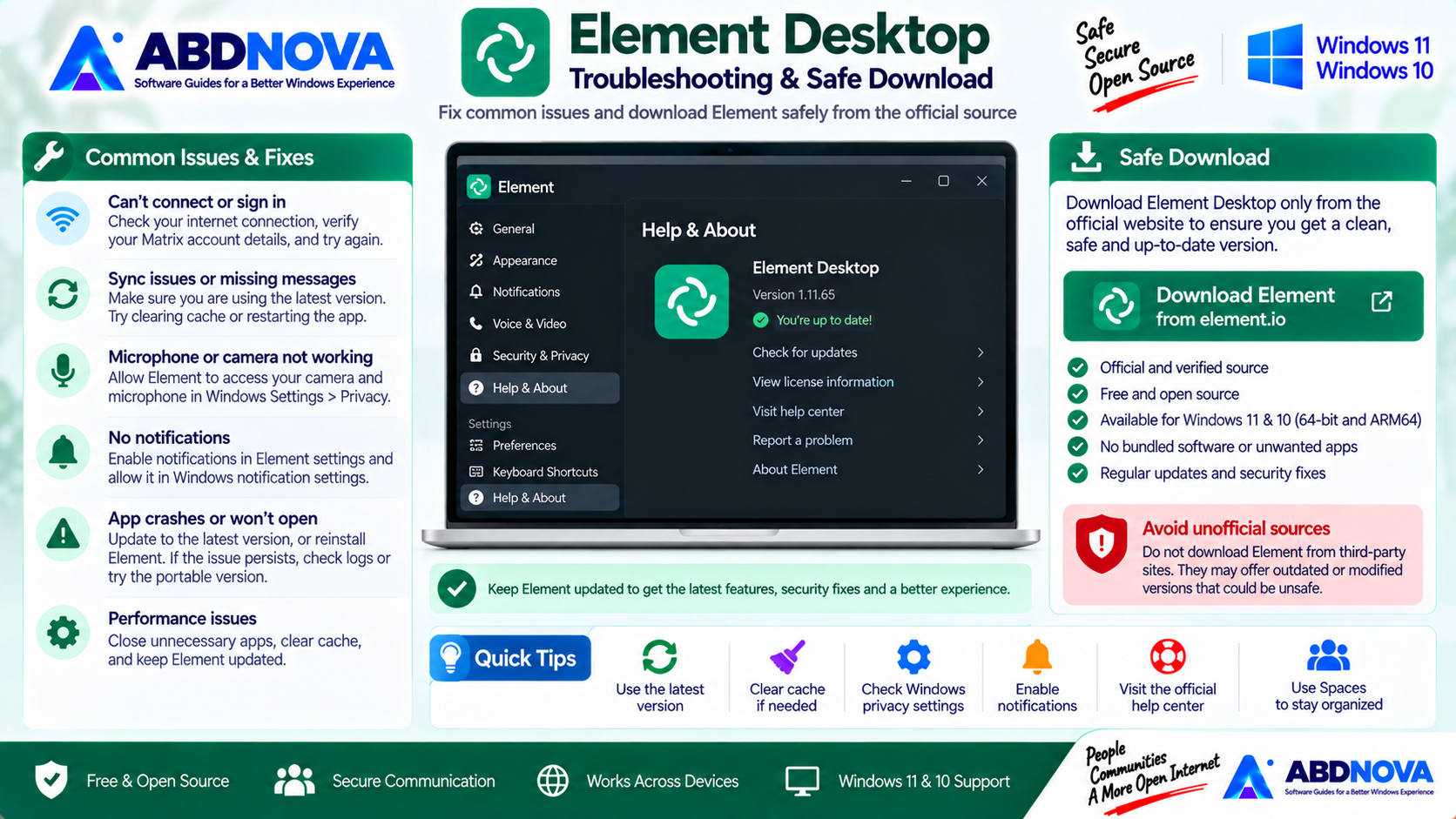
Element Troubleshooting on Windows
Element Desktop Not Opening
If Element does not start correctly:
- Close Element completely.
- Open it again.
- Restart Windows.
- Check your internet connection.
- Make sure Windows is updated.
- Install the latest stable Element Desktop version.
- Reinstall from the official Element installer if necessary.
Cannot Sign In to Element
First check that you are using the correct account details and the correct homeserver.
Matrix accounts can exist on different servers, so using the right username with the wrong homeserver can prevent login.
Also complete any device verification or security prompts that appear after signing in.
Cannot Read Encrypted Messages
If Element displays an encrypted message that cannot be read, the current session may not have the required encryption key.
Secure Backup and device verification are important because they help new or replacement sessions regain access to encrypted history where supported.
Element specifically recommends keeping recovery information secure so you do not lose access to encrypted data. :contentReference[oaicite:8]{index=8}
Element Calls Not Working
If calls fail:
- Check your internet connection.
- Verify microphone permission.
- Verify camera permission for video.
- Make sure Windows is using the correct microphone and camera.
- Restart Element.
- Update Element Desktop.
- Check whether the Matrix server supports the required calling configuration.
Calling availability can depend partly on how the Matrix deployment is configured.
Element File Sharing Not Working
If a file will not send:
- Check the internet connection.
- Try a smaller file.
- Drag the file directly into the conversation.
- Try the attachment control instead.
- Restart Element.
- Update Element Desktop.
How to Update Element Desktop
Keeping Element current is important because it is a security-sensitive communication application.
The current official Windows package repository lists Element Desktop 1.12.27, released September 1, 2026. :contentReference[oaicite:9]{index=9}
If your installation is significantly outdated or updating fails, download the current stable installer directly from Element.
Safe Element Desktop Download
Always download Element Desktop from Element’s official website or official package infrastructure.
Windows 64-bit: Available.
Windows ARM64: Available.
Current stable version: 1.12.27.
Crack required: No.
Activator required: No.
Modified installer required: No.
Element’s personal client is already free, making cracks, activators or pre-activated builds unnecessary.
Frequently Asked Questions
Is Element Desktop available for Windows 11?
Yes. Element provides official Windows 64-bit and ARM64 desktop builds.
Can I use Element Desktop on Windows 10?
Yes, on compatible Windows 10 systems. For a new long-term setup, Windows 11 is preferable where supported.
What is the latest Element Desktop version?
The current official Windows package repository lists Element Desktop 1.12.27, dated September 1, 2026.
What is Matrix?
Matrix is an open standard for decentralized real-time communication. Element is one of the best-known Matrix clients.
Does Element support encrypted messaging?
Yes. Element supports end-to-end encryption in Matrix rooms where encryption is enabled and correctly configured.
Does Element Desktop support voice and video calls?
Yes. Element supports one-to-one and group voice/video communication using its modern calling infrastructure.
Can Element share files?
Yes. Files can be dragged directly into a conversation or selected through the attachment control.
What are Element Spaces?
Spaces provide a way to organize multiple related Matrix rooms into a broader community or workspace structure.
Is Element Desktop free?
Yes. Element’s personal application is free, while paid workplace and enterprise products are also available.
Can I self-host Element?
Yes. Organizations and advanced users can operate their own Matrix infrastructure rather than relying entirely on a centralized provider.
Why is device verification important?
Verification helps confirm that a newly added session genuinely belongs to you and helps protect encrypted communication. Element is also tightening requirements around insecure devices.
Final Thoughts
Element Desktop Download for Windows is a strong option for Windows users who want secure messaging without being locked into a conventional centralized communication platform.
Its combination of Matrix, encrypted rooms, private chats, Spaces, voice and video calls, file sharing, Secure Backup, device verification, federation and optional self-hosting makes it useful for both personal communication and structured collaboration.
Element differs from mainstream messengers because organizations can choose their Matrix provider or operate their own infrastructure while still using compatible Matrix communication.
For most Intel and AMD Windows PCs, use the official 64-bit installer. ARM-based Windows devices should use Element’s dedicated ARM64 build.
Download Element Desktop for Windows
Get the current Windows 64-bit or ARM64 version directly from Element. ABDNOVA recommends official software sources only.